
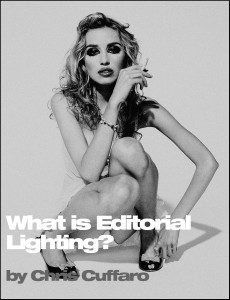
 “Editorial lighting” sounds like it should mean something technical. It doesn’t.
Traditionally, editorial refers to usage, not lighting style. An editorial image runs with a story in a magazine. It supports an article. It builds narrative. Advertising sells a product. Publicity shapes perception. Editorial tells a story.
The light itself? It doesn’t know where it’s going to be published.
What people online now call “editorial lighting” is usually shorthand for a certain look — often moodier, less polished, less commercial-feeling. Maybe harder shadows. Maybe more directional light. Maybe a little imperfection. Sometimes direct flash. Sometimes natural window light. It’s often inspired by fashion magazines from the ’90s and early 2000s. But none of that makes it inherently editorial.
You could use a big soft beauty light and shoot a fashion editorial. You could use harsh on-camera flash for an ad campaign. You could light a publicity portrait exactly the same way you’d light a magazine cover. The gear doesn’t change. The physics don’t change. The light doesn’t change.
What changes is:
• The intent
• The context
• The story
• Where it runs
That’s it.
Back in the day, no one said, “Let’s use editorial lighting because this is for a magazine.” You’d talk about mood. Contrast. Drama. Clean. Gritty. Glam. Natural. Controlled. You’d reference photographers, films, paintings — not labels.
Today’s photography world runs on categories and keywords. “ Editorial lighting” gives YouTubers something searchable. It gives newer photographers a bucket to put things in. It’s branding language more than craft language.
And that’s okay — it’s just a different era.
But you’re not crazy for questioning it. If you used the exact same setup for a publicity shoot and a magazine story, nothing about the light becomes “editorial.” The meaning comes from how the image is used and what it’s supporting.
At the end of the day:
Light is direction.
Light is quality.
Light is contrast.
Light is color.
Light is intention.
Everything else is packaging.
And the real rule still holds — the same one I grew up with:
Let the photo do the talking.




Leave A Comment